2020年5月6日星期三

Overview And How to Use Sterile Syringe Filters

Hawach is available in 6 membrane types: MCE, NYLON, PVDF, PES, PTFE, CA, and other customized materials. The diameter specifications optional include 13mm, 25mm and 33mm. Membrane aperture specifications ranges from 0.22μm to 0.45μm. In practical application, it is easy to use, with media shedding within limits, Gamma ray disinfection and sterilization. Moreover, it do not need heat source and it has easy-to-tear stickers with individual independent packaging. Each filter uses the most advanced PP or MBS as the housing, and the high bonding density ensures the integrity of the sample. It is of easily open outer box design, not easy to pollute. And each packing box has a batch number for easy quality tracking.
The sterile syringe filter is a fast, convenient and reliable filtering device for small volume samples used in the laboratory, which is mainly used in the pre-filtration of samples, the sterilization of laboratory biological fluid, medium and media additives. This product chooses DuPont dialysis paper, printing exquisite, gamma ray sterilization more thorough. The filtration diameter is 13 mm, 25 mm, 33 mm, and the treatment capacity ranged from 0.5 mL to 200 ml.
The sterile syringe filter is some kind of quick, convenient and reliable filtering treatment device for little samples that is regularly used in the laboratory. In general, it is mainly applied for the pre-filtration of samples and sterile filtration of the laboratory biofluid, culture medium and media additive.
Sterile Hydrophilic PTFE Syringe FiltersSterile PVDF Syringe FiltersSterile MCE Syringe Filters
When referring to the features of the sterile syringe filter, there are a lot of that can be summarized as per below:
1. Most of the sterile syringe filter use Tyvek which has high effect of retaining bacteria;
2. Basically, there are 6 types of membrane that are used in the sterile syringe filter: MCE, Nylon, PVDF, PES, PTFE and CA; 3. The pore sizes of the membrane are 0.22 μm and 0.45 μm;
4. It is easy to operate and the media loss can be controlled within limited bounds;
5. It is disinfected and sterilized by gamma ray;
6. Every single product has an individual package with sticker that is easy to tear;
7. Every single product package has a batch number which is easy for quality trace.
On the whole, Hawach sterile syringe filters very suitable for the filtration of liquid, electronics, semiconductor industry, microelectronic water, tissue culture-medium, beverages, high-purity chemicals, water, organic solutions and other mobile phases. In addition, there is no need for the laboratory workers to replace the filter membranes and clean the filters, as a result, it can save much working time by using the sterile syringe filters.
Mostly, the sterile syringe filters can be used in below applications:
1. The ultra-fast filtration of tissue culture-medium, additives and other water solutions;
2. Applications that have extremely low requirement for protein adsorption and those can improve the recovery rate of precious components;
3. The sterile filtration of biological and pharmaceutical industries;
4. The end-filtration of high purity water of electronic industry;
5. The end-filtration of ink;
6. The end-filtration of food, beverages and wine.
Moreover, the structure designs of sterile syringe filters are precise to ensure smooth filtration. Also, the inner space is optimal to keep a very low residual rate. Normally, one of the disadvantages of traditional filters is easy to blasting. However, the sterile syringe filters are specially designed and they can bear the blasting pressure of up to 7 bar.
Overview And How to Use Sterile Syringe Filters

Operation Instructions Of Adjustable Quantitative Liquid Feeder

The instrument is divided into two types: internal and external.It is the use of syringe plunger reciprocating movement and two one-way piston liquid quantitative, directional movement, adding liquid.
Method of use
(1)The internal loading type is composed of liquid storage bottle and liquid feeder. The liquid feeder is a plastic screw-mouth bottle cap, which is connected with the syringe of the outlet pipe and the inlet pipe of the one-way piston to control the inlet and outlet of the test fluid. On the top of the bottle cap, there is a metal scale labeled locating stem and movable locating sleeve to control the accuracy of the amount of added liquid.Connect a glass tube with a plastic tube on the cap to export the sample.
At the end of the glass bend, there is a frosted nozzle to connect the plastic suction nozzle to control the flow rate. Among them, the model 111 adds a liquid hole on the bottle cap, and its scale positioning stem is metal in the core, the outside is made of hard plastic zigzag positioning, in the adjustment of capacity is more convenient and correct.Liquid storage bottle is a glass bottle with screw mouth for storing test liquid. The screw head matches the screw head of the bottle cap.
(2)External loading is to install the syringe syringe with one-way automatic piston outlet pipe and inlet pipe together with the positioning stem and positioning sleeve with calibration marks.
Clean all the apparatus and connect the rubber pipe of the outlet pipe with the outlet curved glass pipe on the bottle cap. The end of the curved glass tube is inserted into the plastic suction nozzle, and then the test fluid is added into the liquid storage bottle. The liquid storage bottle and the liquid filler are screwed tightly with the screw mouth, pumped up and down several times, and then the bubbles in the bottle can be discharged. Before use, the positioning sleeve is moved to the calibration mark on the positioning stem and fixed according to the amount of liquid needed. Continuous refueling can be carried out. If more precision is needed in the process of use, type 111 can be used on the one hand, and correct fixed positioning sleeve can be used after the calibration of capacity on the other hand.
Type 111: align the upper convex part of the positioning sleeve with the center of the two rows of teeth of the positioning stem, and then move upward to the calibration level of the required amount of liquid. Then rotate left or right to insert the teeth on the positioning sleeve into the tooth groove on the positioning stem, and slightly tighten the positioning screw to position. Do not unscrew the cap of the bottle when the test is used up. Remove the inlet cap, install a funnel to fill the required sample into the bottle, and then close the lid.  At the same time, align the hole in the lid with the gap in the inlet, so that the gas can flow back. After using, rotate the inlet cap until the hole is closed, so as to avoid liquid volatilization.
Main features:
The applicator disinfects the entire high temperature and high pressure.
The silicone tube of liquid feeder is made of special material, durable and not easy to crack.
Easy to use, reliable, high efficiency, small repetition error, can save the time and cost of research and experiment.
The parts of the feeder that touch the liquid are made of glass and polypropylene, which do not react chemically in the same way.
The upper and lower one-way piston and the glass plunger of the liquid feeder are precisely ground, the sealing property is good, and the accuracy of the liquid dosage is guaranteed.
Maintenance:
If it is not used for a long time, it must be used to clean the liquid several times, so that the piston and plunger clean, so as to avoid piston and plunger card dead;
In the use of crystallized or impurity liquid, should be in the end of the inlet pipe with a filter net, to prevent the solid material stuck piston, plunger, thus affecting the accuracy of the liquid and normal use.
Purpose description:
Adjustable quantitative liquid feeder is suitable for continuous quantitative liquid feeder of all kinds of liquids in laboratory and laboratory, and can be used in petrochemical, public health, metallurgy, scientific research, environmental protection and other industries.
limited
Now “adjustable quantitative liquid plus” has been widely used in the hospital clinical laboratory continuous charging and various other laboratory reagents, and the original manual method (manually adding reagent through a straw), compared with convenient, reliable and repetitive error is small, the advantages of saving time and cost, but the product use limitations, namely each liquid “adjustable quantitative plus” can only hold a reagent for this reagent) and continuous charging.
In many experiments, several reagents need to be mixed proportionally before use and then added quantitatively to each reaction tube. Projects such as raids (often do the determination of calcium and magnesium ions and muscle, liver, its operations are mixed with Ⅱ amount of reagent Ⅰ quantitatively added to the reaction tube, convenient for adding reagent, part of the hospital is also used by the “adjustable quantitative add accumulator”, reagent and method is to put the reagent Ⅰ Ⅱ respective pour into a liquid “adjustable quantitative plus”, then in turn of the two reagents for continuous charging, the downside is not according to operation procedure, great error; Reagents need to be added twice, troublesome and time-consuming.
The reagentⅠ before another method is in use and Ⅱ blending and pour into a liquid “adjustable quantitative plus” in the continuous charging, the downside is need before using blender, very troublesome, with mixed reagent on hold too long can’t use, resulting in waste. In order to solve these problems in practical work, the utility model refits the original “adjustable quantitative liquid feeder” and designs the utility model, which has the advantages of automatically mixing reagents in proportion in the liquid feeder and continuously adding several reagents at one time without causing waste.

Spray Drying Method

Principle of spray drying method

There are many types of drying methods, but the spray drying method is the most widely used one. It refers to atomizing the liquid to be dried into tiny droplets in the drying chamber and let the droplets directly contact and mix with the hot gas of the drying medium to evaporate the water, and then collecting it by gas-solid separation to obtain a powder or granular product. The raw material liquid may be a solution, an emulsion, or a suspension, or maybe a molten liquid or a paste. The drying medium can be air, nitrogen, or superheated steam.

Applications of spray drying method

Spray drying method is very popular among users in pharmaceutical and food industries since spray drying machine can meet the GMP requirements of the two fields and has superior performance. It is especially suitable for the drying and granulation of Chinese and Western medicines and foods. Granules prepared have strong disintegration, good fluidity, and instant solubility, and can be directly used for tableting, capsule filling, granules, and solid drinks.
Spray drying method is also widely used in dye drying. It can dry dye fine powder, super-fine powder, dust-free powder, and hollow granules. This method can be divided into three categories:
(1) airflow atomization, which uses compressed air or water vapor to atomize the material liquid;
(2) pressure atomization, a high-pressure pump is applied to press out the material liquid from the nozzle at high speed and thus forming a mist;
(3) rotary atomization, the material liquid is added to the high-speed rotating disc (7000 ~ 28000r / min) in the atomizer, and then the material liquid is quickly thrown out and atomized. The third category — rotary atomization has a good effect, short time, and high labor productivity, which is favored by the dyestuff industry. But it needs large equipment investment and high energy consumption.
Spray drying method is a representative of systematic technology applied to material drying. After the material is atomized in the drying chamber, the moisture quickly vaporizes in contact with the hot air to obtain the dried product. This method can save the steps of evaporation and crushing. Spray drying method has the characteristics of fast heat-transfer, rapid water evaporation, and short drying time. It can improve the dissolution rate of certain formulations, suitable for heat-sensitive drugs. In addition, spray drying can be used to prepare microcapsules.

Advantages of spray drying method

1. Rapid drying process.
2. Materials can be directly dried into powder.
3. It is easy to change the drying conditions and adjust product quality standards.
4. There is a certain negative pressure in the drying room, which guarantees the hygienic conditions in the production, avoids the dust flying in the workshop, and improves the purity of the product.
5. High production efficiency and fewer operators.
6. Large production capacity and high product quality. The spray volume can reach several hundred tons per hour.

Disadvantages of spray drying method

1. The equipment is complex, covers a large area, and requires a large investment.
2. The price of a spray dryer and powder recovery device is relatively high.
3. The thermal efficiency is not high and the heat consumption is large.

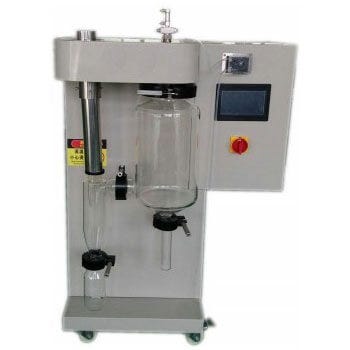
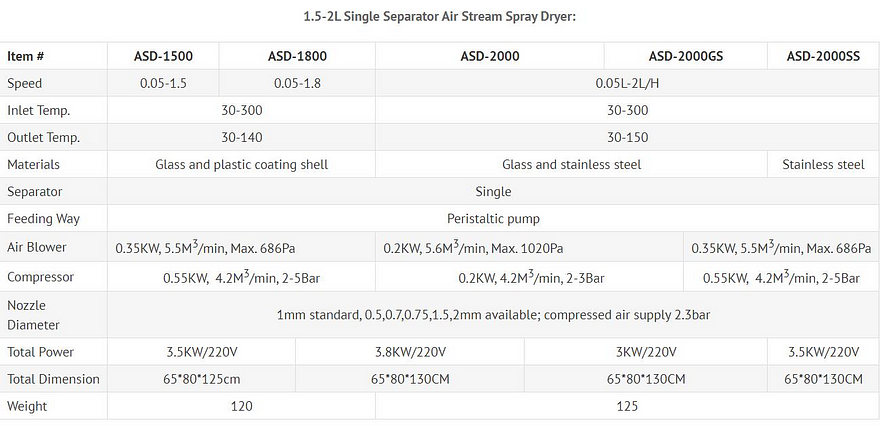
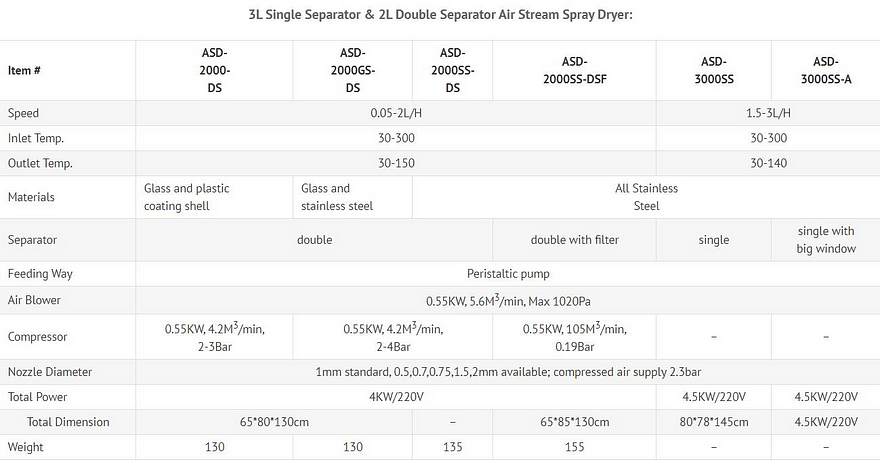
Airstream Small Spray Dryer (1.5L/h-3L/h)

Max. Process Volume: 1.5L/H, 1.8L/H, 2L/H, 3L/H
Speed: 0.05–1.5L/H, 0.05–1.8L/H, 0.05–2L/H, 1.5–3L/H
Inlet Temp.: 30–300°C
Outlet Temp.: 30–140°C, 30–150°C, 30–300°C
Material: three coating shells available: glass and plastic shell, glass and stainless steel shell, all stainless steel shell.
Different from industrial spray dryer that is used in large production, air-stream spraying dryer is a small spray dryer that is mostly seen in the laboratory and some pint-sized production occasions.

Features of Hawach’s airstream small spray dryer

1. Small spray dryer, easy to operate.
2. All sizes and configurations are available for your different needs.
3. Coating shell materials vary glass & plastic, glass & stainless steel, all stainless steel benchtop spray dryer.
4. Single or double separator to choose from.
5. Big sight window spray dryer available.
6. Two fluid nozzles, anti-corrosion benchtop spray dryer.
7. LCD touch screen equipped, directly showing the inlet temperature/outlet temperature / peristaltic pump speed/air volume/needle frequency.
8. Fully automatic control and manual control combined to meet different occasions.
9. Lab spray dryer with high-quality oil-free compressor, lower noise (<60db ) produced during operation.
10. PID control, high-temperature stability, 1°C temperature error small spray dryer.
11. Material purity guaranteed due to the efficient cyclone separator, which separates the reaction materials from the exhaust gas.
12. Automatically-cleared jet with adjustable frequency. When the nozzle is blocked, it will be automatically cleared to ensure the continuity of the experiment.
13. 95% evenness-rate powder after drying.

Classification of Hawach’s airstream small spray dryer

1.From coating material:
Glass & plastic: concise and beautiful, visible spray drying process for its glass drying chamber, suitable for general or small spray drying experiments, lab spray dryer as a representative.
Glass & stainless steel: high acid and alkali resistance, anti-corrosion, can be used in the corrosion-resistant environment.
All stainless steel: stainless steel housing, acid, and alkali resistant, corrosion-resistant, visible drying process, can be used in corrosion-resistant environments and environments with flammable, explosive, and volatile substances.
2.From separators:
Single separator and double separators
3.Others:
Standard benchtop spray dryer and dryer equipped with big sight window.

Applications of Hawach’s airstream small spray dryer

Lab spray dryer and benchtop spray dryer are all air-stream type dryer. These small spray dryers are suitable for acquiring micro-particulate powder, thus often be used in universities, research institutes and laboratories, food, pharmaceutical, and chemical companies. It is universally applicable to all solutions such as emulsions and suspensions.
1. Chemical industry: raw materials of battery, basic dye pigments, dye intermediates, compound fertilizers, formaldehyde silicic acid, catalysts, sulfuric acid agents, amino acids, silica, etc.
2. Plastic resin: AB, ABS emulsion, urea-formaldehyde resin, phenolic resin, dense glue (urea) formaldehyde resin, polyethylene, polyvinyl chloride, etc.
3. Food industry: fat-rich milk powder, prion, cocoa milk powder, milk replacer, animal blood powder, etc.
4. Food and plants: oatmeal, chicken juice, coffee, instant tea, flavored meat, protein, soy, peanut protein, hydrolysate, etc.
5. Sugars: corn syrup, corn starch, glucose, pectin, maltose, potassium sorbate, etc.
6. Ceramics: alumina, ceramic tile materials, magnesium oxide, talc, etc.

Parameters of Hawach’s airstream small spray dryer


Spray Dryer In Milk Powder

Spray drying of milk powder is a widely applied technology in liquid forming and drying industry. It is suitable for producing powders and granular solid products from liquid solution, emulsion, suspension and paste liquid raw materials. Therefore, spray drying is an ideal process when the particle size distribution, residual water content, bulk density and particle shape of finished products must conform to the standard.
Milk powder spray dryer principle is air filtration and heating, enter the dryer top air distributor, the hot air spiral into the drying chamber evenly. The liquid with the high speed centrifugal atomizeris swiftly atomized through the top of the tower and it is atomized into tiny droplets of mist and contacted with the hot air. spray dryer can be dried into finished products in a very short time.
The finished product is continuously output from the bottom of the drying tower and the cyclone separator, and the waste gas is discharged by the fan.
Centrifugal Spray Dryer 5L
The application advantages of milk freeze-dried milk powder are as follows:
1. As the whole process is carried out in a low-temperature (<50 ° C) oxygen-depleted vacuum environment, its nutritional components are hardly lost or damaged, and the natural flavor, quality and color of the milk powder remain unchanged. Limits the nutrients in raw milk, especially heat-resistant active substances. Large amounts of nutritional components such as heat-sensitive substances (destruction rate of protein, vitamins, etc.> 35%) and active substances in raw milk caused by the existing high-temperature sterilization process are avoided.
2. Bringing the original pure and natural high-nutrition milk powder to consumers. Experimental spray dryers, especially immunoglobulins, EGF (epidermal growth factor) and other active substances in milk are of important nutritional and health significance to infants and the elderly. Currently freeze-dried milk powder is a blank in the market;
3. The rehydration (reconstitution) grade of milk powder is good. Due to the large amount of honeycomb pores caused by the direct vaporization of water during lyophilization, the state of reconstituted raw milk can be completed in a few seconds, making drinking more convenient.
4. Convenient storage and longer shelf life.
5. The freeze-dried milk powder of the experimental spray dryer has a large internal surface area, is easy to absorb moisture and oxidize, and requires vacuum-sealed packaging. It can be generally used as a packaging unit according to different consumer groups, and it is not easy to use large-quantity packaging.
6. It is estimated that the one-time investment of equipment is large, and the processing cost is basically the same as the existing milk powder production (thermal processing) cost.
7. Due to its natural, nutritious and convenient characteristics, freeze-dried food is now becoming a new food hotspot in Japan, Korea, Europe, and the United States, and is gradually becoming the trend of the world food revolution.

Application of Molecular Distillation Technology in Purifying Lubricating Oil

Conditions for molecular distillation:
1. The partial pressure of the residual gas should be very low so that the average free path length of the residual gas is a multiple of the distance between the surface of the distiller and the condenser.
2. At saturation pressure, the average free path length of the vapor molecules should be of the same order of magnitude as the distance between the surface of the evaporator and the condenser.
Under these ideal conditions, evaporation occurs from residual gas molecules without any obstacles. The vapor molecules reach the condenser surface without encountering other molecules and returning to the liquid. The evaporation rate reaches a possible value at the temperature. The evaporation rate is proportional to the pressure, so the amount of distillate from molecular distillation is relatively small.
In large and medium-sized short-path distillation, the distance between the condenser and the heating surface is about 20 ~ 50mm, and the residual gas molecules have an average free path length of about 2 times longer when the residual gas pressure is 10-3mbar. The short path distiller can reach the conditions of molecular distillation.
molecular-distillation-equipment-a1-type-hot-sale
The basic steps of the molecular distillation process
Short-path distiller is also suitable for molecular distillation. The molecular flow goes directly from the heating surface to the condenser surface. The molecular distillation process can be made in the following four steps:
1. Molecules diffuse from the liquid phase to the evaporation surface
Generally, the diffusion rate in the liquid phase is the main factor that controls the molecular distillation rate, so the thickness of the liquid layer should be reduced.
2. Free evaporation of molecules on the surface of the liquid layer
The evaporation rate increases with increasing temperature, but the separation factor sometimes decreases with increasing temperature. Therefore, the economic and reasonable distillation temperature should be selected on the premise of the thermal stability of the processed material.
3. The molecules fly from the evaporation surface to the condensation surface
Vapor molecules flying from the evaporation surface to the condensation surface may collide with each other or may collide with air molecules remaining between the two surfaces. Since evaporating molecules are much heavier than air molecules, and most of them have the same direction of motion, their collisions have little effect on the direction of flying and the rate of evaporation. The residual gas molecules are in chaotic thermal motion between the two sides, so the number of residual gas molecules is the main factor that affects the direction of flight and the rate of evaporation.
4. Molecules condense on the condensation surface
As long as there is a temperature difference between the cold and hot sides (generally 70 ~ 100 ℃), the form of the condensation surface is reasonable and smooth, it is considered that the condensation step can be completed, so it is very important to choose a reasonable condenser form.
Application of molecular distillation technology in purifying lubricating oil
Silicone compound is good lubricating oil, which can improve the smoothness of the disc and the stability of the disc under different humidity and high temperature.
Since siloxane compounds are heat-sensitive substances and have boiling points above 200 ℃, conventional distillation separation methods are easy to denature, and molecular distillation can not only greatly reduce the content of color-forming substances in lubricating oil, but also make the same amount of distillation The time of siloxane is reduced by 40%. At the same time, the molecular distillation technology is also used to purify erucamide to make its mass fraction reach more than 98%.

The Salient Features Of Hawach Vacuum Filtrations

Glass Solvent Filters
Glass solvent filter is standing equipment in the chemical laboratory, it can choose different material, different filter pore size filter membrane according to the needs of operators, so as to achieve the purpose of impurity, purification and sterilization insolvent. It is suitable for filtration and degassing of the mobile phase in liquid chromatography analysis, which plays a key role in prolonging the service life of instrument and column and improving the detection accuracy. It has also been widely used in gravimetric analysis, microanalysis, colloid separation, and aseptic experiments.
Glass Three-Branches Vacuum Filtrations
Glass Vacuum Filtration
Firstly, the suction flask of glass vacuum filtration is made of high borosilicate glass materials and has excellent chemical and physical properties. Also, the glass vacuum filtrations are equipped with the borosilicate Buchner funnel and filtering membrane which have good chemical properties.
Secondly, the friction plug of the glass vacuum filtration is mostly designed with special PTFE materials of advanced technology. It has high corrosion resistance and good cost performance.
Thirdly, the parts of sample loading and unloading are specially designed PTFE valves with glass flanges. In general, they are free of dead corners and easy to disassemble for the unloading of solid samples.
Fourthly, the whole part of the glass vacuum filtration has good sealing property and the negative pressure can reach under 0.095 MPa in the stationary state.
Fifthly, the structure design of the whole part of glass vacuum filtration is scientific. The feature of visualization is outstanding and practical.
Furthermore, the frame and pipe of the glass vacuum filtration are mostly made of stainless steel. When referring to the desktop support, normally it is movable.
On the whole, the glass vacuum filtration is applied in the liquid-liquid extraction. In most situations, it can be also used as a normal temperature reaction filtration.
Stainless-Steel Vacuum Filtrations
The stainless-steel vacuum filtrations are suitable for filtrations of large amounts of samples in the laboratory. Normally, the whole part of the filter holder manifolds is made of stainless steel materials with good corrosion resistance. In general, the stainless-steel vacuum filtrations are mostly applied for all kinds of vacuum filtration experiments in the laboratory, such as the detection and filtration of microorganisms and suspended solids.
Furthermore, the features of stainless-steel vacuum filtrations are listed as per below:
1. The whole part of equipment including the filter cups switch and filter holder manifolds are all made of stainless steel materials. They have good corrosion resistance as well as excellent durability;
2. In most cases, the waste liquid bottles are made of polycarbonate materials with a certain resistance to the mill. In the meantime, the bottles can be put into the autoclave for sterilization;
3. There is a cut-off valve inside of the waste liquid bottle. After the waste liquid bottle is full, the cut-off valve will automatically turn off and effectively prevent the waste liquid from being absorbed into the vacuum pump and further damaging it;
4. The stainless-steel vacuum filtrations are fully equipped with various types of units and thus keep the users out of troubles with installation.